Timor-Leste might be a young country in terms of independence, but when it comes to culture, it carries centuries, even millennia, of history on its shoulders. And one of the clearest signs of that? The way people speak. This small Southeast Asian nation is home to over 30 indigenous languages, each with its own sound, rhythm, and story to tell.
In today’s world, where globalisation often sweeps away smaller languages, Timor-Leste is something of an exception. Here, local languages are not just surviving — they’re part of everyday life, woven into greetings at the market, storytelling by the fire, and the songs sung during ceremonies. They’re not just tools for talking; they’re keepers of identity, memory, and community pride.
Many Voices, One Nation
Geography has played a big part in keeping Timor-Leste’s linguistic landscape so rich. High mountains, winding valleys, and far-reaching coastlines meant that communities stayed isolated for centuries. This allowed languages to grow separately, developing unique words, grammar, and ways of expression.
Officially, Tetum and Portuguese share the national language title. But the reality on the ground is far more colourful. Linguists usually group Timor-Leste’s languages into two families:
- Austronesian languages — found mostly in coastal and central regions.
- Papuan (non-Austronesian) languages — concentrated in the eastern and central highlands.
You’ll hear well-known names like Mambae, Makasae, Fataluku, Kemak, Bunak, Tokodede, Galolen, and Baikeno. But many other tongues, spoken by just a few thousand people, are still very much alive — each one a cultural treasure.
Languages in Daily Life
In Timor-Leste, being multilingual is not a skill people brag about — it’s simply the way life works. Someone might speak Tetum at the market, switch to Makasae with family at home, use Portuguese in a classroom, and chat in Indonesian with an older neighbour who remembers the occupation years.
In rural areas, local languages dominate daily life. Tetum might only appear when talking to outsiders. In Dili or other towns, Tetum and Portuguese mix freely, but as soon as people discover they share the same hometown, the conversation flips into their shared mother tongue.
Language here is not only about communication — it’s about connection and respect.
Why So Many Languages Survive
Elsewhere, small indigenous languages have been swallowed up by more dominant ones. But in Timor-Leste, several things have worked in favour of survival:
- Strong identity — Speaking your own language shows where you belong.
- Geography — Remote landscapes kept communities apart.
- Tradition — Songs, rituals, and oral histories are kept in their original words.
- Elders — Older generations keep speaking and passing the language down naturally.
The Role of Tetum and Portuguese
Tetum is the country’s bridge language. It comes in two main forms: Tetum Prasa, which borrows heavily from Portuguese, and Tetum Terik, which is more traditional. Portuguese, while official, is mostly reserved for government, law, and education.
Instead of replacing other languages, Tetum tends to live alongside them. At a wedding, for example, you might hear the official speeches in Tetum, followed by laughter and singing in a local dialect once the formalities are over.
Culture Lives Through Language
Here, language is culture. Weddings, harvest celebrations, community meetings — they are carried out in the mother tongue. Ritual speeches use a poetic style filled with repetition and symbolism that simply cannot be translated without losing its meaning.
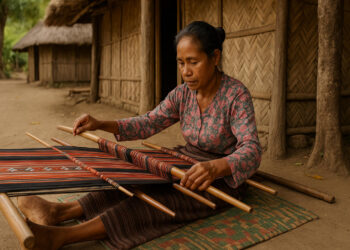
Many skills and traditions, from weaving tais cloth to specific farming practices, are taught in local languages. Losing a language could mean losing the knowledge tied to it.
Challenges Ahead
Urban migration, global media, and schooling in Tetum and Portuguese mean that some young people grow up without speaking their ancestral tongue fluently. For smaller languages — some spoken by just a few thousand — this could mean they disappear within a generation. Linguists have already listed several as “vulnerable” or “endangered.”
Preservation in Action
Since independence in 2002, efforts have been made to safeguard linguistic diversity:
- Some primary schools now teach in the mother tongue for the first years before introducing Tetum and Portuguese.
- Linguists are recording grammar, vocabulary, and oral traditions.
- Community radio stations broadcast in languages like Mambae and Fataluku.
- Cultural festivals put traditional songs, poetry, and speeches on stage.
The Instituto Nacional de Linguística has also developed written forms for several languages, helping to produce books and teaching materials.
Unity in Diversity
Far from dividing the nation, Timor-Leste’s many languages have become a symbol of unity. Leaders often start speeches with greetings in several local tongues. National celebrations feature banners saying “welcome” in dozens of languages — a reminder that variety is one of the country’s greatest strengths.
Words with Hidden Worlds
Each language holds knowledge and ideas you can’t simply translate. Fataluku has words for specific winds and sea currents vital for fishing. Mambae ceremonial speech is rich with layered metaphors. Makasae stories mix humour with lessons about life, history, and morality.
These words carry practical, cultural, and spiritual meaning — and losing them would mean losing those worlds.
The Road Ahead
The future of Timor-Leste’s languages depends on keeping a balance. Tetum and Portuguese will continue to unite the nation and connect it internationally. But the lullabies in Fataluku, the blessings in Kemak, and the prayers in Bunak keep the nation’s cultural heartbeat alive.
Young Timorese are helping — making TikTok videos, posting songs on YouTube, or writing poems in their own languages. Sometimes, these go viral, sparking pride not just at home, but among the diaspora.
A Living Tapestry
Think of Timor-Leste’s 30-plus indigenous languages as threads in a living tapestry. Each one adds colour and depth. Take one away, and the pattern loses something. Keep them all, and the picture stays vibrant and whole.
In a world where many languages are disappearing forever, Timor-Leste is proving that diversity can survive — if people keep speaking, teaching, and loving the words that tell their stories.
Also read, Tais Weaving – The Timorese Art Form the World is Finally Recognising